

Passover Communion
- Mar 24
- 3 min read

PASSOVER
This is a short, structured service—often called a Christian Seder or Passover Communion—designed to bridge the Old Testament story of the Exodus with the New Testament fulfilment in Jesus.
It can be done as a full meal, usually a roast Lamb meal. Or as a short service without the meal.
Have a Seder plate on the table from the beginning. If doing the full meal, this is usually done at the end.
What you will need to make up the Seder plate:
Lettuce
A bitter herb like Horseradish
A mixture of chopped apples, nuts, wine/juice, and cinnamon.
Parsley or Celery
Lamb either as part of the meal or another symbolic lamb portion
Boiled egg
Salt water
Flat bread
The Opening: Lighting the Candles
The service begins with the lighting of two candles, symbolising the transition from the ordinary to the sacred.
Leader: "Blessed are You, O Lord our God, King of the Universe, who has kept us alive and sustained us to this day. As we light these candles, we remember that Jesus is the Light of the World, the light that no darkness can overcome."
The First Cup: The Cup of Sanctification
Pour a small amount of grape juice or wine.
Leader: "God promised His people: 'I will bring you out from under the yoke of the Egyptians.' We thank God for setting us apart and calling us His own."
All: Drink the first cup.
The Elements of Remembrance: The Seder Plate
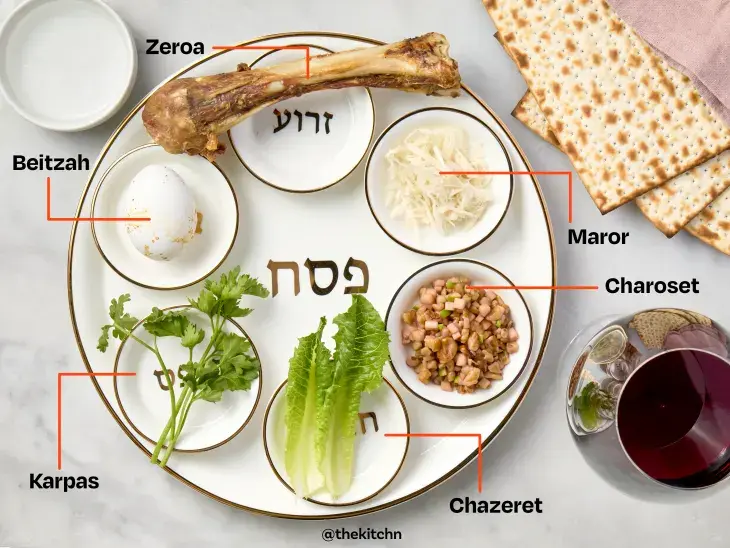
Explain the symbols on the table:
1. Maror (Bitter Herbs)
Item: Usually prepared horseradish or romaine lettuce.
Symbolism: Represents the bitterness of slavery in Egypt. In a Christian context, it also reminds us of the bitterness of sin that Christ took upon Himself on the cross.
2. Chazeret (Second Bitter Herb)
Item: Often another form of horseradish or a bitter green.
Symbolism: Used specifically to make the "Hillel Sandwich" (eating the herb between two pieces of Matzah). It reinforces the theme that redemption often comes in the midst of suffering.
3. Charoset (Sweet Paste)
Item: A mixture of chopped apples, nuts, wine/juice, and cinnamon.
Symbolism: Its texture looks like the mortar the Israelites used to make bricks for Pharaoh. Its sweetness represents the hope and the "sweetness" of God’s promise of deliverance.
4. Karpas (Green Vegetable)
Item: Parsley, celery.
Symbolism: Represents springtime, rebirth, and new life. During the Seder, it is dipped in salt water (representing tears) to show that new life often comes through a season of sorrow.
5. Zeroah (Shank Bone) in Jewish circles only a bone is used to represent the loss of the temple and the inability to sacrifice the Passover Lamb. As Christians we are not bound by this lack, as Jesus is our Lamb.
Item: Roast lamb; either as part of the meal or separately on the plate.
Symbolism: It represents the Passover Lamb sacrificed so the Angel of Death would pass over the Israelites. For Christians, this points directly to Jesus, the "Lamb of God."
6. Beitzah (Roasted Egg)
Item: A hard-boiled egg.
Symbolism: Represents the festival sacrifice offered at the Temple. It also symbolizes mourning for the destruction of the Temple and the circle of life—reminding us that even in death, there is the promise of resurrection.
7. Salt Water: For dipping the Karpas; represents the sweat and tears of the slaves.
8. Matzah (Unleavened Bread): Three pieces are usually kept in a special pouch or stacked under a cloth, representing the "bread of haste."
The Story (The Haggadah)
Leader: "Why is this night different from all other nights?"
Response: "On this night, we remember how God heard the cries of His people in Egypt. He struck the firstborn of Egypt but passed over the houses marked with the blood of the lamb. We also remember that Jesus, our Paschal Lamb, was sacrificed so that death would pass over us, giving us eternal life."
The Breaking of Bread (Matzah) Flat Bread is suitable.
Hold up the bread.
Leader: "This is the bread of affliction. It has no leaven, just as we are called to remove the leaven of malice and wickedness from our hearts." Break the bread and pass it.
Leader: "Jesus took the bread, gave thanks and broke it, saying, 'This is my body given for you; do this in remembrance of me.'"
The Second Cup: The Cup of Redemption
Pour the second cup.
Leader: "This cup represents the promise: 'I will redeem you with an outstretched arm.' After supper, Jesus took the cup, saying, 'This cup is the new covenant in my blood, which is poured out for you.'"
All: Drink in silence, reflecting on the sacrifice of Christ.
Closing: A Song of Praise
Traditionally, the Hallel (Psalms 113-118) are sung or read.
Leader: "It is finished. The lamb has been slain, the debt has been paid, and the grave is empty. Go in the peace of Christ."
